Paper References
38 references
[1]Y. Tong, H. Liu, and Z. Zhang, "Advancements in humanoid robots: A comprehensive review and future prospects," IEEE/CAA Journal of Automatica Sinica, vol. 11, no. 2, pp. 301-328, 2024.
[2]B. Porter, "The problems with humanoid robots," 2024. [Online]. Available: https://medium.com/@bp64302/the-problems-with-humanoid-robots-9d8684d62008
[3]Y. Yang, L. Zhao, M. Ding, G. Bertasius, and D. Szafir, "BOSS: Benchmark for observation space shift in long-horizon task," IEEE Robotics and Automation Letters, vol. 10, no. 9, pp. 8882-8889, 2025.
[4]K. Kawaharazuka et al., "Real-world robot applications of foundation models: a review," Advanced Robotics, vol. 38, no. 18, pp. 1232-1254, 2024.
[5]J. Bjorck et al., "Gr00t n1: An open foundation model for generalist humanoid robots," arXiv preprint arXiv:2503.14734, 2025.
[6]E. K. Raptis, A. C. Kapoutsis, and E. B. Kosmatopoulos, "Agentic LLM-based robotic systems for real-world applications: a review on their agenticness and ethics," Frontiers in Robotics and AI, vol. 12, p. 1605405, 2025.
[7]K. Zhang et al., "Ro-Bridge: A hierarchical architecture bridging cognition and execution for general robotic manipulation," arXiv, 2025.
[8]M. Ahn et al., "AutoRT: Embodied foundation models for large scale orchestration of robotic agents," arXiv, 2024.
[9]M. Ahn et al., "Do as i can, not as i say: Grounding language in robotic affordances," arXiv, 2022.
[10]B. Zitkovich et al., "RT-2: Vision-language-action models transfer web knowledge to robotic control," in Proceedings of The 7th Conference on Robot Learning, PMLR, 2023.
[11]K. Black et al., "π0: A vision-language-action flow model for general robot control." arXiv preprint ARXIV.2410.24164.
[12]M. J. Kim et al., "OpenVLA: An open-source vision-language-action model," arXiv, 2024.
[13]A. O'Neill et al., "Open x-embodiment: Robotic learning datasets and RT-x models," 2024 IEEE International Conference on Robotics and Automation (ICRA), vol. 00, pp. 6892-6903, 2024.
[14]Z. Bai et al., "Hallucination of multimodal large language models: A survey," arXiv, 2024.
[15]F. Sun et al., "A comprehensive survey on embodied intelligence: Advancements, challenges, and future perspectives," CAAI Artificial Intelligence Research, p. 9150042, 2024.
[16]A. Robey et al., "Jailbreaking LLM-controlled robots," arXiv, 2024.
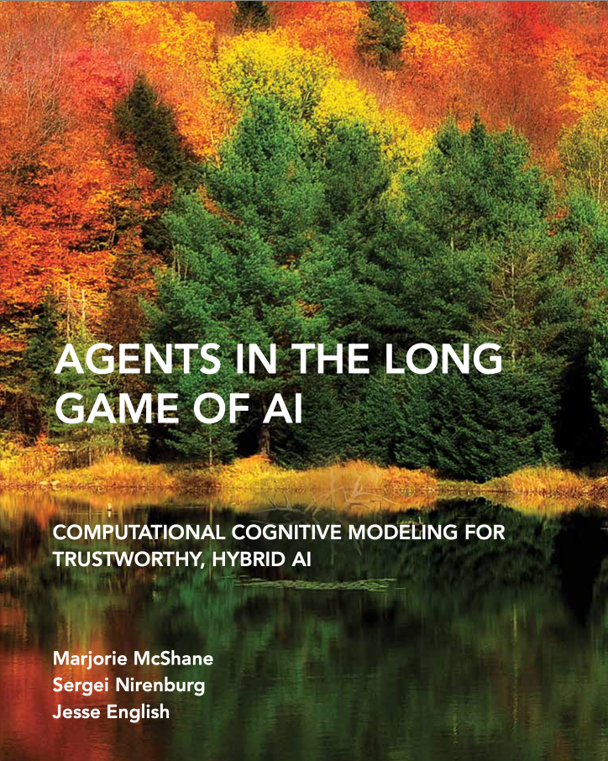
[17]M. McShane, S. Nirenburg, and J. English, Agents in the Long Game of AI: Computational Cognitive Modeling for Trustworthy, Hybrid AI. Cambridge, MA: MIT Press, 2024.
[18]S. Nirenburg et al., "Explaining explaining," Proceedings of the 1st International Conference on Explainable AI for Neural and Symbolic Methods, pp. 116-123, 2024.
[19]S. Nirenburg et al., "Toward human-like robot learning," in International Conference on Applications of Natural Language to Information Systems. Springer, 2018.
[20]L. A. Dennis et al., "Practical verification of decision-making in agent-based autonomous systems," Automated Software Engineering, vol. 23, no. 3, pp. 305-359, 2016.
[21]M. Scheutz et al., "Novel mechanisms for natural human-robot interactions in the diarc architecture," in Proceedings of AAAI workshop on intelligent robotic systems. Palo Alto, CA, 2013, p. 66.
[22]P. W. Schermerhorn et al., "Diarc: A testbed for natural human-robot interaction." in AAAI, vol. 6, 2006, pp. 1972-1973.
[23]J. English and S. Nirenburg, "OntoAgent: Implementing content-centric cognitive models," in Proceedings of the Annual Conference on Advances in Cognitive Systems, 2020.
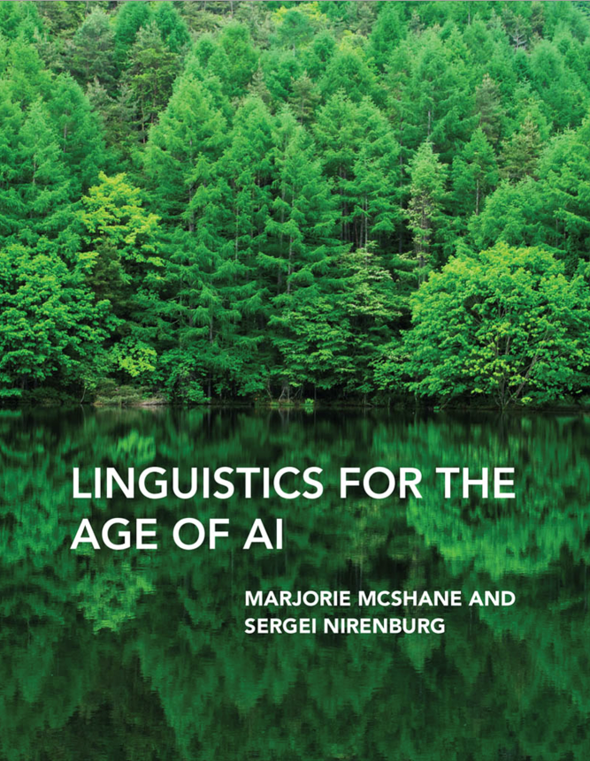
[24]M. McShane and S. Nirenburg, Linguistics for the Age of AI. Cambridge, MA: MIT Press, 2021.
[25]S. Nirenburg, T. Ferguson, and M. McShane, "Mutual trust in human-ai teams relies on metacognition," in Metacognitive Artificial Intelligence. Cambridge University Press, 2024.
[26]M. Colledanchise and P. Ögren, Behavior Trees in Robotics and AI: An Introduction. CRC Press, 2018.
[27]M. Iannotta et al., "Heterogeneous full-body control of a mobile manipulator with behavior trees," arXiv preprint arXiv:2210.08600, 2022.
[28]S. S. O. Venkata, R. Parasuraman, and R. Pidaparti, "Kt-bt: A framework for knowledge transfer through behavior trees in multirobot systems," IEEE Transactions on Robotics, vol. 39, no. 5, pp. 4114-4130, 2023.
[29]M. Colledanchise and L. Natale, "On the implementation of behavior trees in robotics," IEEE Robotics and Automation Letters, vol. 6, no. 3, pp. 5929-5936, 2021.
[30]D. Kahneman, Thinking, Fast and Slow. Macmillan, 2011.
[31]J. E. Laird, The Soar Cognitive Architecture. Cambridge, MA: MIT Press, 2012.
[32]F. E. Ritter, J. R. Anderson et al., "Act-r: A cognitive architecture for modeling cognition," Wiley Interdisciplinary Reviews: Cognitive Science, vol. 10, no. 3, p. e1488, 2019.
[33]M. Scheutz et al., "An overview of the distributed integrated cognition affect and reflection diarc architecture," Intelligent Systems, Control and Automation: Science and Engineering, pp. 165-193, 2019.
[34]J. E. Laird, P. S. Rosenbloom, and A. Newell, "Robo-soar: An integration of external interaction, planning, and learning using soar," Robotics and Autonomous Systems, vol. 8, no. 1-2, pp. 113-129, 1991.
[35]J.-Y. Puigbo et al., "Using a cognitive architecture for general purpose service robot control," Connection Science, vol. 27, no. 2, pp. 105-117, 2015.
[36]S. Harnad, "The symbol grounding problem," Physica D: Nonlinear Phenomena, vol. 42, no. 1-3, pp. 335-346, 1990.
[37]J. G. Trafton et al., "Act-r/e: An embodied cognitive architecture for human-robot interaction," Journal of Human-Robot Interaction, vol. 2, no. 1, pp. 30-55, 2013.
[38]M. Scheutz, R. Cantrell, and P. Schermerhorn, "Toward humanlike task-based dialogue processing for human robot interaction," AI Magazine, vol. 32, no. 4, pp. 77-84, 2011.
Related Publications
Deep dives into the cognitive foundations of HARMONIC